Your AI agent does not ask permission. That is the point. It analyses, decides, and acts — faster than any human workflow, at a scale no human team can match. That is why you deployed it. And that is exactly why, without the right governance controls in place, it can cause serious harm before anyone in your organisation realises something has gone wrong.
This is not a technology problem. It is a governance problem. And it is one that most organisations are not yet equipped to handle — because agentic AI creates accountability challenges that traditional software controls were never designed to address.
The Autonomy Gap Nobody Is Talking About
Traditional software does what it is programmed to do. Every output is the result of a rule someone wrote. When it fails, you trace the failure to the code. You fix the code. Done.
Agentic AI is different in kind, not just degree. It uses planning and reasoning to decide what to do next. It retains memory across interactions. It invokes tools, calls APIs, modifies data, and communicates with other agents — all based on its own judgment. Nobody wrote a rule for every situation it will encounter. That is not a flaw in the design. It is the design.
The consequence is that agentic AI can make decisions or take actions that were never explicitly anticipated by the people who built it. In multi-agent systems — where multiple specialised agents collaborate under a coordinating agent — this unpredictability multiplies. Emergent behaviours arise that no single agent was designed to produce. And when something goes wrong, determining which agent, which team, or which design decision is accountable becomes genuinely difficult.
The governance gap:
Without governance frameworks built specifically for this environment, organisations are deploying systems that can act consequentially with no clear lines of responsibility, no audit trail, and no reliable way to stop the damage once it starts.
What Happens When There Is No Governance
Consider what agentic AI systems are actually doing in production environments today. A shopping agent has authority to spend money on behalf of users. A coding agent has write access to production repositories. A data agent has read access to customer records. A scheduling agent can commit resources on behalf of your organisation.
Now remove the governance layer. No audit logging to reconstruct what happened. No access controls to restrict what the agent can touch. No human approval gates on high-stakes actions. No compliance checkpoints before deployment. No standard operating procedures defining who can authorise a model update.
Failure Mode: Shopping Agent — Unexpected Spending
A shopping agent spends money unexpectedly on behalf of users with no audit trail to reconstruct the decision pathway.
Failure Mode: Coding Agent — Production Repository Compromise
A coding agent pushes a repository full of bugs into production, or worse, executes malicious code with write access to production systems.
Failure Mode: Data Agent — Sensitive Information Leakage
A data agent inadvertently leaks sensitive information to an unauthorised party. None of these are theoretical scenarios. They are documented failure modes from systems operating in production right now.
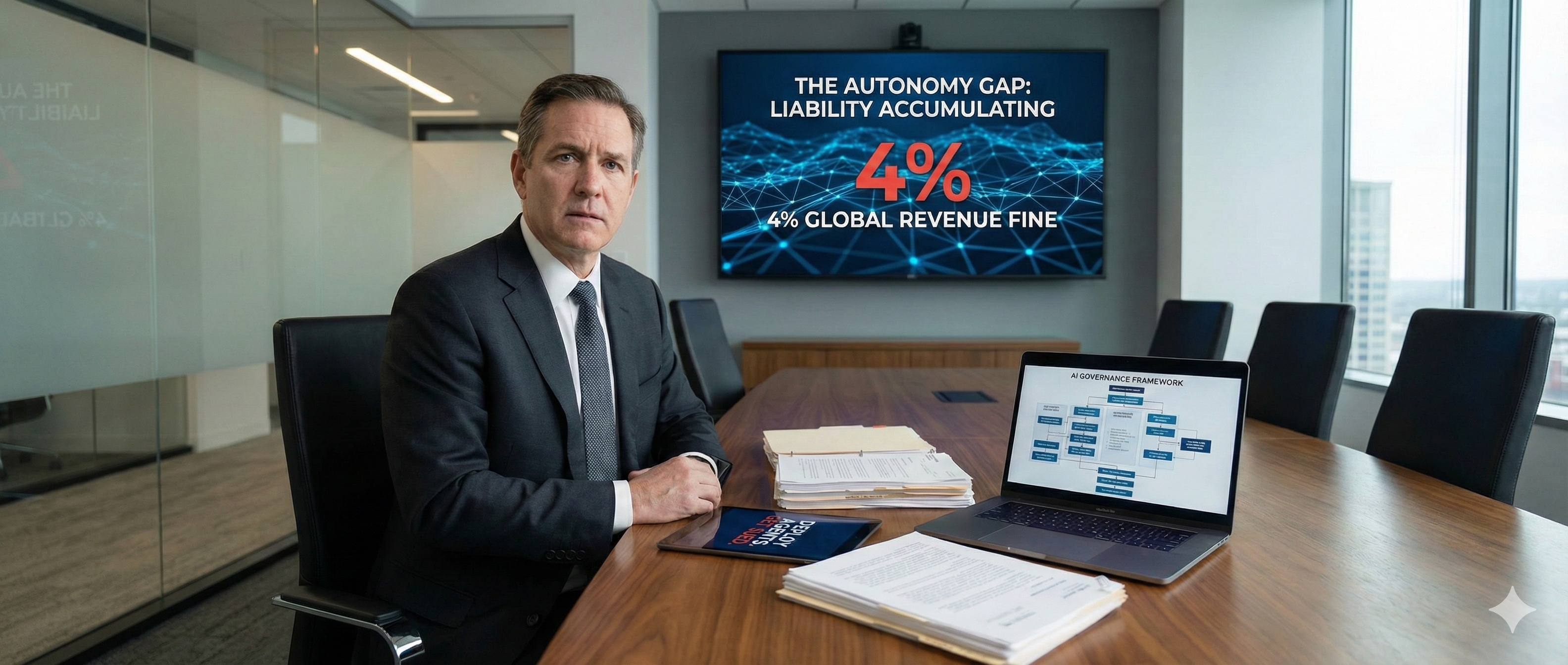
The financial consequences are direct. GDPR violations carry fines of up to 4% of global annual revenue. In healthcare and finance, non-compliance can mean suspension of operations or loss of licences. And beyond the regulatory exposure, there is the reputational damage that does not show up in a fine notice — the erosion of trust with customers, partners, and regulators that takes years to rebuild.
Here is the problem that makes this worse: when agent systems fail without governance in place, you often cannot determine what happened. You cannot trace the decision pathway. You cannot identify which input led to which output through which reasoning step. You cannot assign accountability. You cannot demonstrate to regulators that you had adequate controls. And you cannot prevent it from happening again — because you do not understand what caused it the first time.
The Governance Challenges That Make This Hard
Challenge 1: Accountability Without Clear Lines of Responsibility
Who is accountable when an AI agent causes harm? The developer who built it? The team that deployed it? The organisation that operates it? In traditional software, this question has established answers. In agentic AI, it does not. If an agent with update privileges modifies another agent or a system component in ways that cause a downstream failure, the accountability chain becomes nearly impossible to reconstruct without explicit frameworks defining responsibility at every point.
Challenge 2: Access Control Beyond User Permissions
Traditional access controls manage what people can do. Agentic AI requires managing what agents can do — and what agents can do to other agents. Unauthorised agent-to-agent communication is a real and underappreciated threat vector. One compromised or malfunctioning agent can pass malicious instructions to other agents, spreading harm across a system designed to operate at scale. Standard role-based access controls were not built for this problem.
Challenge 3: Compliance in a Rapidly Changing Regulatory Landscape
The EU AI Act classifies AI systems by risk level and imposes different requirements at each level. GDPR requires that individuals can request explanations of automated decisions that affect them. HIPAA requires strict controls on health data regardless of what system processes it. Most organisations do not have clear visibility into which regulations apply to which AI systems. Without that visibility, compliance is ad hoc — relying on individual teams to identify requirements rather than systematic organisational processes.
Governance Is Not Bureaucracy. It Is the Architecture of Trust.
The organisations getting this right are not the ones with the most restrictive controls. They are the ones with the most deliberate ones. Governance frameworks that are too rigid stifle the innovation that makes agentic AI valuable in the first place. The goal is not to constrain what your agents can do. It is to ensure that when they act, they act within boundaries that protect your organisation, your customers, and your reputation.
That requires seven interconnected governance layers — accountability frameworks, access control policies, audit logging and traceability, human-in-the-loop oversight, compliance management, standard operating procedures, and risk controls built specifically for autonomous systems. Each layer addresses something the others cannot. No single mechanism is sufficient. Together, they create a governance architecture that gives your agents the freedom to operate and your organisation the controls to remain accountable.
Your AI agents are making decisions right now. The governance framework that makes them accountable is either in place — or it is not.
Deploy Agents. Get Sued.
What you just read covers the problem. The full 47-page governance framework covers everything you need to solve it — from accountability structures to compliance matrices to the access control architecture your multi-agent systems are missing right now.
What the full report reveals:
Get the full report — no cost, immediate access.
No spam. No sales calls. The framework delivered instantly to your inbox.
No spam. No sales calls. The framework delivered instantly to your inbox.
Good. Keep reading — the solution is right below.
The full report is also on its way to your inbox. Scroll down to continue reading now.
Layer 1: Accountability Frameworks
The foundation of AI governance begins with establishing clear ownership and responsibility structures using proven frameworks.
Layer 1: NIST AI RMF and Impact Assessment Templates
Establish clear ownership at every level using the NIST AI Risk Management Framework and the Co-designed AI Impact Assessment Template. Define who is responsible for AI decisions, how those decisions are reviewed, and what happens when something goes wrong. Building from scratch is a mistake when proven frameworks exist.
Layer 2: Access Control Policies for Agentic AI
Control what agents can access, what agents can do to other agents, and enforce segregation of duties without breaking your deployment pipeline. Traditional role-based access controls are insufficient for agent-to-agent communication. Purpose-built access control architectures prevent unauthorised lateral movement between agents.
Layer 3: Audit Logging and Traceability
Capture structured logs at every layer — request, decision, action, and model. Store them immutably. Reconstruct complete decision pathways when regulators ask. Without traceability, you cannot investigate incidents, assign accountability, or demonstrate compliance.
Layer 4: Human-in-the-Loop Oversight
Implement transparency and control principles that keep humans meaningfully in charge without slowing autonomous operations to a crawl. Risk classification determines which actions proceed automatically and which require human approval, balancing operational speed with meaningful oversight.
Layer 5: Compliance Management and Regulatory Mapping
Build a compliance matrix that maps every AI system to applicable regulations — GDPR, HIPAA, CCPA, EU AI Act. Implement automated checkpoints that block non-compliant deployments before they reach production. Systematic compliance replaces ad hoc team-level guesswork.
Layer 6: Standard Operating Procedures
Model validation, deployment authority, incident response, and the training programmes that turn governance documents into organisational behaviour. Without SOPs, governance exists on paper but not in practice.
Layer 7: Risk Management and Safety Controls
Guardrails at input, process, and output layers. Simulations and digital twins for safe testing. And the trust-building and repair mechanisms that determine whether agent failures damage your organisation permanently or temporarily.